
Costs and Affordability•Assisted Living
Understanding Long-Term Care Insurance: CALSTRS, FLTCIP, and How to Access Your Benefits
Costs and Affordability•Assisted Living
Understanding Long-Term Care Insurance: CALSTRS, FLTCIP, and How to Access Your Benefits
This guide will help you understand:
· How to access long-term care insurance benefits
· What an elimination or “grace” period means
· The types of services typically covered
· Why inflation protection matters
· What families should review before filing a claim
What Is Long-Term Care Insurance?
Long-term care insurance helps pay for custodial or supportive care when someone can no longer independently perform activities of daily living such as:
· Bathing
· Dressing
· Eating
· Toileting
· Transferring
· Continence
Many policies also cover cognitive impairments such as Alzheimer’s disease or other forms of dementia.
Programs such as FLTCIP were created specifically to help federal employees and retirees prepare for future care expenses. CALSTRS members may also have access to long-term care coverage options through affiliated programs. (calstrs.com)

How Do You Access the Money?
One of the biggest misconceptions about long-term care insurance is that benefits automatically begin once someone is diagnosed with an illness.
Most policies require a “benefit trigger” before payments begin. In general, the insured person must:
1. Need assistance with at least two Activities of Daily Living (ADLs), OR
2. Have a qualifying cognitive impairment such as dementia or Alzheimer’s disease.
Once this threshold is met, the family typically contacts the insurance company to open a claim.
The insurance carrier may then:
· Request medical records
· Conduct a nursing assessment
· Evaluate cognitive functioning
· Review care plans
· Approve covered services
Most companies assign a care coordinator or claims representative to guide families through the process. (acl.gov)
Understanding the “Grace Period” or Elimination Period
Many families are surprised to learn that long-term care insurance does not usually begin paying immediately.
Most policies include what is called an elimination period. This is essentially a waiting period before benefits begin. Think of it like a deductible measured in time instead of dollars.
Common elimination periods include:
· 30 days
· 60 days
· 90 days
· 180 days
During this time, families are typically responsible for paying care expenses out of pocket. (comparelongtermcare.org)
Important Questions to Ask
Not all elimination periods work the same way.
Some policies count calendar days, while others only count days when paid care services are received.
For example:
· A 90-calendar-day elimination period lasts approximately 3 months.
· A 90-service-day elimination period could take much longer if care is only provided a few days per week.
This distinction becomes extremely important for home care situations. (ltctree.com)
What Services Are Usually Covered?
Coverage varies by policy, but many long-term care plans help pay for:
In-Home Care
· Caregivers and aides
· Companion care
· Assistance with bathing and dressing
· Meal preparation
· Medication reminders
Adult Day Care Centers
Many policies cover licensed adult day care programs that provide:
· Structured activities
· Social engagement
· Cognitive stimulation
· Meals and supervision
· Respite for caregivers
These centers can be especially valuable for individuals with dementia because they provide routine and social interaction while giving caregivers time to rest.

Assisted Living Facilities
Policies may help pay for:
· Room and board
· Medication management
· Personal care services
· Memory care support
Skilled Nursing or Nursing Homes
Coverage may extend to:
· Skilled nursing facilities
· Rehabilitation support
· Long-term custodial care
Hospice and Respite Care
Some plans also include:
· Hospice support
· Temporary respite care
· Informal caregiver assistance
FLTCIP specifically states that it may help cover nursing home care, assisted living, hospice care, respite care, and formal or informal care provided in the home. (fedweek.com)
Why Inflation Protection Matters
One of the most overlooked clauses in long-term care insurance is inflation protection.
Long-term care costs continue to rise each year. A policy purchased 20 years ago with a $150 daily benefit may no longer adequately cover today’s care costs unless it includes inflation adjustments.
Some policies include:
· Simple inflation protection
· Compound inflation protection
· Guaranteed benefit increases
· Optional future purchase increases
Inflation riders help increase the daily or monthly payout amount over time so benefits keep pace with rising care costs. (cpdemo.ltcg.com)
What Families Should Look For
Review the policy carefully and look for language such as:
· “Inflation Protection”
· “Automatic Benefit Increase”
· “Compound Growth Rider”
· “Future Purchase Option”
· “Cost of Living Adjustment (COLA)”
A 5% compound inflation rider can dramatically increase available benefits over decades.
For example:
· A $150 daily benefit with 5% compound inflation could potentially grow to over $390 per day after 20 years.
This can make an enormous difference when paying for assisted living or memory care.
Important Documents Families Should Gather
Before filing a claim, families should organize:
· The insurance policy or benefit booklet
· Premium payment history
· Medical records
· Physician assessments
· Medication lists
· Care plans
· Power of Attorney paperwork
Keeping organized documentation can significantly speed up claim approval.
Current FLTCIP Enrollment Suspension
Families should also be aware that the Federal Long Term Care Insurance Program is currently under an application suspension period.
As of late 2024, new applications and coverage increases were suspended due to rising long-term care costs and market instability. Current enrollees, however, remain eligible to use their existing benefits. (ltcfeds.gov)
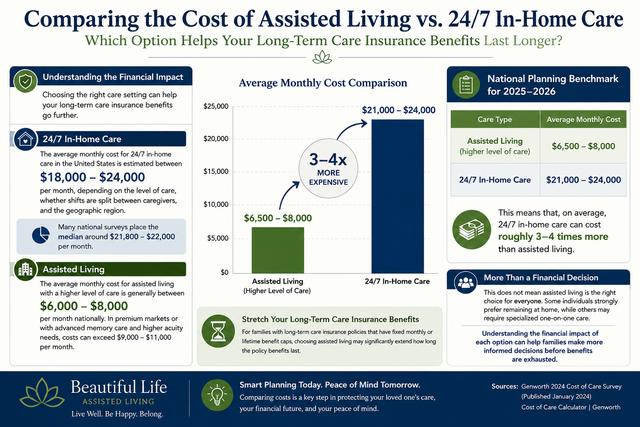
Comparing the Cost of Assisted Living vs. 24/7 In-Home Care
One of the most important financial considerations families face when activating a long-term care insurance policy is deciding whether care at home or assisted living will stretch benefits further.
The average monthly cost for 24/7 in-home care in the United States is currently estimated between $18,000 and $24,000 per month, depending on the level of care, whether shifts are split between caregivers, and the geographic region. Many national surveys place the median around $21,800–$22,000 per month.
By comparison, the average monthly cost for assisted living with a higher level of care is generally between $6,000 and $8,000 per month nationally. In premium markets or with advanced memory care and higher acuity needs, costs can exceed $9,000–$11,000 per month.
National Planning Benchmark for 2025–2026, according to Genworth
Assisted Living (higher level of care) Monthly Average $6,500-$8,000
24/7 In-Home Care Monthly Average: $21,00-$24,000
Long-term care insurance can provide tremendous financial relief when families are facing dementia, chronic illness, or aging-related care needs. However, understanding how the policy works before a crisis occurs is essential.
Families should pay close attention to:
· Elimination periods
· Benefit triggers
· Covered services
· Daily or monthly benefit caps
· Inflation protection clauses
· Home care versus facility coverage
The earlier families review these details, the easier it becomes to access benefits when care is urgently needed.
If you or a loved one has a long-term care insurance policy through CALSTRS, FLTCIP, or a private insurer, now is the time to review the policy and understand exactly what benefits are available.
Being proactive today can help prevent confusion, delays, and unnecessary financial stress tomorrow.
Sources
· CALSTRS Long-Term Care Information
· Federal Long Term Care Insurance Program (FLTCIP)
· Administration for Community Living
· Federal Register Notices Regarding FLTCIP
· Long-Term Care Claims and Elimination Period Resources